Where it came from
Japan, where native hemlocks tolerate it and predators keep it in check.
How it got here
First found in Virginia in 1951, probably on imported Japanese hemlock nursery stock. It spread slowly at first, then rapidly through the Appalachians and the Northeast from the 1980s on. It reached Long Island in the late 1980s and has been killing our hemlocks ever since.
What it does to the ecosystem
The aphid-like insects feed at the base of needles, starving the tree of stored nutrients. Needles drop, branches die from the bottom up, and the tree dies in 4 to 10 years. Hemlocks shade cold streams; when they die, brook trout and salamanders lose habitat and the streams warm.
What it costs
Hemlock has been effectively eliminated from much of the southern Appalachians. In New York, land managers spend heavily on insecticide treatments for high-value trees and on releasing predator beetles.
Don’t confuse it with
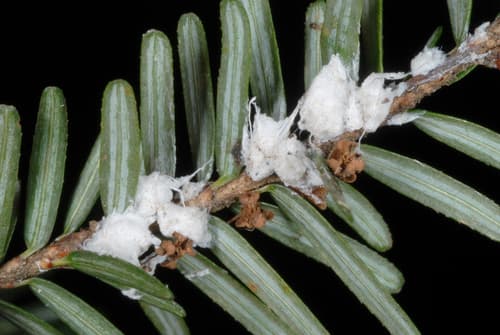
- Spider egg sacs and spittlebugs. Adelgid wool is always at the base of individual needles on the underside of twigs, in neat rows, and cannot be wiped off cleanly. Spittlebug foam is wet and on stems.
How to identify it
White cottony tufts at the base of hemlock needles on the underside of twigs, most visible in late winter and spring.
What to do
Trees can be treated by an arborist. Report infested hemlocks in preserves.
On Long Island
Most wild hemlocks in the North Shore ravines are dead or dying. Landscape hemlocks can be kept alive with treatment every few years. Check the undersides of twigs in March.
Worth knowing
- All adelgids in North America are female and reproduce without mating, so a single one can start a population.
- They are active in winter and dormant in summer, the reverse of most insects.
- Two predator beetles, Laricobius and Sasajiscymnus, have been released in New York and are establishing.