Looking up observations…
Zip code tool
Native Plant Finder
Enter a zip code and we'll match native plants to your region and USDA hardiness zone, show which ones people have already documented growing near you, and let you filter by sun, soil, and what you want to attract.
47 plants in the database
Browse the whole database
Enter a zip code above to filter by native range and hardiness zone and to see which plants have been documented near you.
- Shrub
Northern spicebush
Lindera benzoin
First shrub to bloom in the woods, host of the spicebush swallowtail, and its red berries fuel migrating thrushes. Replaces bush honeysuckle.
Host for: Spicebush swallowtail, promethea moth
- Height
- 6–12 ft
- Sun
- Part–Shade
- Soil
- Medium–Wet
Blooms Mar–Apr · yellow
- Ground cover
Moss phlox
Phlox subulata
Evergreen carpet that blooms in April for the first butterflies and bees of spring.
- Height
- 4–6 in
- Sun
- Full
- Soil
- Dry
Blooms Apr–May · pink, lavender, white
- Perennial
Wild red columbine
Aquilegia canadensis
Nodding spring flowers timed for returning hummingbirds; self-sows in rocky shade.
Host for: Columbine duskywing
- Height
- 1–2 ft
- Sun
- Part–Shade
- Soil
- Dry–Medium
Blooms Apr–May · red and yellow
- Perennial
Wild geranium
Geranium maculatum
Spring woodland flower that mining bees and bumble bee queens rely on when emerging.
- Height
- 1–2 ft
- Sun
- Part–Shade
- Soil
- Medium
Blooms Apr–Jun · lilac pink
- Ground cover
Foamflower
Tiarella cordifolia
Frothy spring spikes for small bees over semi-evergreen maple-shaped leaves; a superb native ground cover to replace English ivy or pachysandra.
- Height
- 6–12 in
- Sun
- Part–Shade
- Soil
- Medium
Blooms Apr–May · white
- Ground cover
Golden ragwort
Packera aurea
Evergreen ground cover that smothers weeds and blooms bright yellow for early bees; a native alternative to lesser celandine.
- Height
- 1–2 ft
- Sun
- Part–Shade
- Soil
- Medium–Wet
Blooms Apr–May · yellow
- Ground cover
Common blue violet
Viola sororia
The lawn weed that is actually the sole host plant of fritillary butterflies; let it be.
Host for: Great spangled fritillary and other fritillaries
- Height
- 4–8 in
- Sun
- Full–Part–Shade
- Soil
- Medium
Blooms Apr–May · violet
- Ground cover
Woodland stonecrop
Sedum ternatum
The native sedum: a shade-tolerant succulent ground cover with starry spring flowers for small bees.
- Height
- 3–6 in
- Sun
- Part–Shade
- Soil
- Dry–Medium
Blooms Apr–May · white
- Perennial
Lyreleaf sage
Salvia lyrata
The native salvia: purple-tinged rosettes and spring flower spikes for bees and hummingbirds; tolerates mowing.
- Height
- 1–2 ft
- Sun
- Full–Part
- Soil
- Dry–Medium
Blooms Apr–Jun · lavender-blue
- Shrub
Highbush blueberry
Vaccinium corymbosum
Spring bells for bumble bee queens and specialist blueberry bees, summer fruit for birds (and you), scarlet fall color. Replaces burning bush.
Host for: Over 280 caterpillar species
- Height
- 6–10 ft
- Sun
- Full–Part
- Soil
- Medium–Wet
Blooms Apr–May · white bells; red fall color
- Tree
Serviceberry (shadbush)
Amelanchier canadensis
White April blossoms for early bees, June berries that birds strip in days, and orange fall color. The native replacement for Callery pear.
Host for: Red-spotted purple, viceroy
- Height
- 15–25 ft
- Sun
- Full–Part
- Soil
- Medium
Blooms Apr–Apr · white
- Tree
Eastern redbud
Cercis canadensis
Magenta pea flowers along bare branches in April, a lifeline for emerging bumble bee queens and mason bees.
Host for: Henry's elfin
- Height
- 20–30 ft
- Sun
- Full–Part
- Soil
- Medium
Blooms Apr–Apr · magenta
- Perennial
Foxglove beardtongue
Penstemon digitalis
Early-summer tubular flowers for bumble bees and hummingbirds, bridging the gap before coneflowers open.
- Height
- 2–4 ft
- Sun
- Full–Part
- Soil
- Dry–Medium
Blooms May–Jun · white
- Perennial
Golden Alexanders
Zizia aurea
Spring umbels for tiny bees and a host plant for black swallowtail caterpillars.
Host for: Black swallowtail
- Height
- 1–3 ft
- Sun
- Full–Part
- Soil
- Medium–Wet
Blooms May–Jun · yellow
- Perennial
Lanceleaf coreopsis
Coreopsis lanceolata
Cheerful early-summer daisies for sandy soil; feeds small bees and later goldfinches.
- Height
- 1–2 ft
- Sun
- Full
- Soil
- Dry
Blooms May–Jul · yellow
- Perennial
Eastern bluestar
Amsonia tabernaemontana
Steel-blue spring stars for early butterflies, then golden willow-like fall foliage.
- Height
- 2–3 ft
- Sun
- Full–Part
- Soil
- Medium
Blooms May–Jun · pale blue
- Tree
White oak
Quercus alba
Oaks host more caterpillar species than any other plant genus in North America (over 500 in the Northeast), which is what feeds nesting songbirds. The most valuable tree you can plant.
Host for: 500+ caterpillar species
- Height
- 60–80 ft
- Sun
- Full
- Soil
- Dry–Medium
Blooms May–May · n/a
- Tree
Black cherry
Prunus serotina
Keystone tree: spring flowers for bees, fruit for dozens of bird species, and host to more than 400 caterpillar species. Replaces tree-of-heaven.
Host for: Eastern tiger swallowtail, red-spotted purple, cecropia moth
- Height
- 50–80 ft
- Sun
- Full–Part
- Soil
- Dry–Medium
Blooms May–May · white
- Perennial
Common milkweed
Asclepias syriaca
The single most important monarch host plant in the East; intensely fragrant flowers feed dozens of bee and butterfly species.
Host for: Monarch, milkweed tussock moth
- Height
- 3–5 ft
- Sun
- Full
- Soil
- Dry–Medium
Blooms Jun–Aug · pink
- Perennial
Butterfly weed
Asclepias tuberosa
Brilliant orange milkweed for sandy, dry soil; a monarch host that fits in small gardens and containers.
Host for: Monarch, queen
- Height
- 1–2 ft
- Sun
- Full
- Soil
- Dry
Blooms Jun–Aug · orange
- Perennial
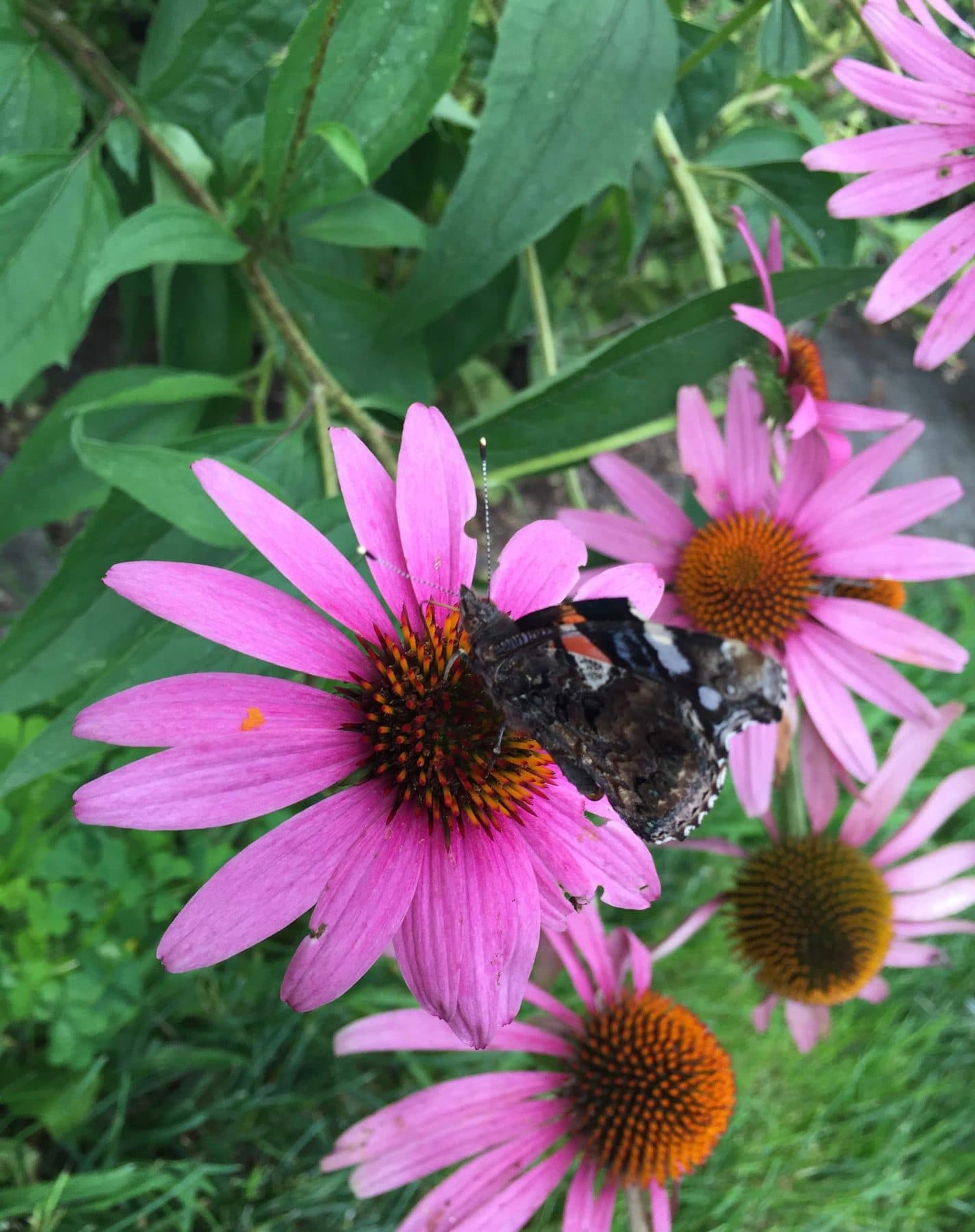
Purple coneflower
Echinacea purpurea
Months of nectar for bumble bees and butterflies, then winter seed for goldfinches.
Host for: Silvery checkerspot
- Height
- 2–4 ft
- Sun
- Full–Part
- Soil
- Dry–Medium
Blooms Jun–Sep · pink-purple
- Perennial
Black-eyed Susan
Rudbeckia hirta
Easy, self-sowing gold daisies that feed small native bees and hoverflies all summer.
Host for: Silvery checkerspot, wavy-lined emerald
- Height
- 1–3 ft
- Sun
- Full–Part
- Soil
- Dry–Medium
Blooms Jun–Sep · gold
- Perennial
False sunflower (oxeye)
Heliopsis helianthoides
One of the longest-blooming native daisies; feeds bees all summer and finches in fall.
- Height
- 3–5 ft
- Sun
- Full–Part
- Soil
- Dry–Medium
Blooms Jun–Sep · gold
- Shrub
Buttonbush
Cephalanthus occidentalis
Golf-ball flower spheres that swallowtails, monarchs, and hummingbirds mob; thrives with wet feet.
Host for: Hydrangea sphinx, titan sphinx
- Height
- 6–12 ft
- Sun
- Full–Part
- Soil
- Wet
Blooms Jun–Aug · white
- Shrub
Winterberry holly
Ilex verticillata
Tiny June flowers feed small bees; brilliant red berries feed robins, bluebirds, and waxwings all winter. Needs a male pollinator plant.
- Height
- 6–10 ft
- Sun
- Full–Part
- Soil
- Medium–Wet
Blooms Jun–Jun · red berries in winter
- Perennial
Swamp milkweed
Asclepias incarnata
A clumping, well-behaved milkweed for damp soil and rain gardens; monarchs prefer its tender leaves for egg-laying.
Host for: Monarch
- Height
- 3–4 ft
- Sun
- Full–Part
- Soil
- Medium–Wet
Blooms Jul–Aug · rose pink
- Perennial
Scarlet bee balm
Monarda didyma
The top hummingbird plant of the Northeast garden; also draws bumble bees and clearwing moths.
- Height
- 2–4 ft
- Sun
- Full–Part
- Soil
- Medium–Wet
Blooms Jul–Aug · red
- Perennial
Wild bergamot
Monarda fistulosa
Drought-tolerant bee balm covered in long-tongued bees and hummingbird moths; a specialist bee, Dufourea monardae, depends on it.
- Height
- 2–4 ft
- Sun
- Full–Part
- Soil
- Dry–Medium
Blooms Jul–Aug · lavender
- Perennial
Joe Pye weed
Eutrochium dubium / E. purpureum
Big dusty-pink domes that tiger swallowtails and monarchs swarm in late summer.
- Height
- 3–7 ft
- Sun
- Full–Part
- Soil
- Medium–Wet
Blooms Jul–Sep · mauve
- Perennial
Garden phlox
Phlox paniculata
Fragrant summer flower heads built for swallowtails, hummingbirds, and hawk moths.
- Height
- 3–5 ft
- Sun
- Full–Part
- Soil
- Medium
Blooms Jul–Sep · pink, purple, white
- Perennial
Dense blazing star
Liatris spicata
Purple bottlebrush spikes that monarchs and swallowtails cover in August.
- Height
- 2–4 ft
- Sun
- Full
- Soil
- Medium–Wet
Blooms Jul–Aug · purple
- Perennial
Clustered mountain mint
Pycnanthemum muticum
Consistently rated the top pollinator plant in Northeast trials: wasps, bees, flies, and butterflies by the hundreds.
- Height
- 2–3 ft
- Sun
- Full–Part
- Soil
- Dry–Medium
Blooms Jul–Sep · silvery white
- Perennial
Woodland sunflower
Helianthus divaricatus
A sunflower for dry shade that supports specialist bees and hosts silvery checkerspots.
Host for: Silvery checkerspot, painted lady
- Height
- 2–5 ft
- Sun
- Part–Shade
- Soil
- Dry–Medium
Blooms Jul–Sep · yellow
- Perennial
Anise hyssop
Agastache foeniculum
Licorice-scented spikes that honey bees, bumble bees, and goldfinches adore; blooms for months.
- Height
- 2–4 ft
- Sun
- Full–Part
- Soil
- Dry–Medium
Blooms Jul–Sep · lavender-blue
- Perennial
Swamp rose mallow
Hibiscus moscheutos
Dinner-plate native hibiscus of Long Island's marsh edges; specialist hibiscus bees and hummingbirds visit.
- Height
- 4–6 ft
- Sun
- Full
- Soil
- Medium–Wet
Blooms Jul–Sep · white or pink
- Perennial
Blue vervain
Verbena hastata
Candelabra spikes for small bees and a native replacement for purple loosestrife in wet meadows.
Host for: Common buckeye
- Height
- 3–5 ft
- Sun
- Full
- Soil
- Medium–Wet
Blooms Jul–Sep · violet-blue
- Perennial
Common evening primrose
Oenothera biennis
Opens at dusk for sphinx moths and specialist evening primrose bees; goldfinches eat the seed.
Host for: Primrose moth, white-lined sphinx
- Height
- 3–5 ft
- Sun
- Full
- Soil
- Dry–Medium
Blooms Jul–Sep · yellow
- Shrub
Sweet pepperbush (summersweet)
Clethra alnifolia
Long Island's own fragrant August shrub; the flowers hum with bees and swallowtails. The native answer to butterfly bush.
- Height
- 4–8 ft
- Sun
- Full–Part–Shade
- Soil
- Medium–Wet
Blooms Jul–Aug · white
- Perennial
Goldenrods (showy, stiff, wrinkleleaf)
Solidago speciosa, S. rigida, S. rugosa
The essential fall nectar plant for migrating monarchs and hundreds of bee species; supports over 100 caterpillar species. Does not cause hay fever.
Host for: Over 100 moth and butterfly species
- Height
- 2–5 ft
- Sun
- Full–Part
- Soil
- Dry–Medium
Blooms Aug–Oct · yellow
- Perennial
White wood aster
Eurybia divaricata
The best native for dry shade under trees; clouds of small white daisies feed late bees where little else blooms.
- Height
- 1–2 ft
- Sun
- Part–Shade
- Soil
- Dry–Medium
Blooms Aug–Oct · white
- Grasse
Little bluestem
Schizachyrium scoparium
Host grass for several skipper butterflies; copper winter color and seed for sparrows.
Host for: Leonard's, cobweb, and dusted skippers
- Height
- 2–4 ft
- Sun
- Full
- Soil
- Dry–Medium
Blooms Aug–Sep · copper fall color
- Grasse
Switchgrass
Panicum virgatum
Tough upright grass for screens and rain gardens; shelters overwintering insects and feeds birds.
Host for: Several skippers
- Height
- 3–6 ft
- Sun
- Full
- Soil
- Dry–Medium–Wet
Blooms Aug–Sep · airy tan seed heads
- Perennial
Cardinal flower
Lobelia cardinalis
The reddest flower in the East, pollinated almost exclusively by ruby-throated hummingbirds.
- Height
- 2–4 ft
- Sun
- Full–Part
- Soil
- Wet
Blooms Aug–Sep · scarlet
- Perennial
New York ironweed
Vernonia noveboracensis
Tall, deer-proof magenta flowers that monarchs and swallowtails favor in late summer.
- Height
- 5–7 ft
- Sun
- Full
- Soil
- Medium–Wet
Blooms Aug–Sep · magenta
- Perennial
White turtlehead
Chelone glabra
The host plant for the Baltimore checkerspot; bumble bees force their way into the turtle-shaped flowers.
Host for: Baltimore checkerspot
- Height
- 2–3 ft
- Sun
- Part–Shade
- Soil
- Wet
Blooms Aug–Sep · white
- Perennial
New England aster
Symphyotrichum novae-angliae
Late purple daisies that pair with goldenrod to fuel the monarch migration and the last bees of the year.
Host for: Pearl crescent
- Height
- 3–6 ft
- Sun
- Full
- Soil
- Medium–Wet
Blooms Sep–Oct · purple
- Perennial
Smooth blue aster
Symphyotrichum laeve
A tidy, mildew-free aster for dry soil, buzzing with small bees in October.
Host for: Pearl crescent
- Height
- 2–4 ft
- Sun
- Full–Part
- Soil
- Dry–Medium
Blooms Sep–Oct · sky blue
FAQ
About the finder
- What does native mean here?
- A plant that occurred in your region before European settlement and co-evolved with local insects. Our database records native range at the regional level (Northeast, Mid-Atlantic, Southeast, Midwest, Plains, Mountain West, Pacific, Southwest) based on USDA PLANTS and BONAP county data. For county-level detail, check the New York Flora Atlas or your state's atlas.
- Why does my zone matter if the plant is native?
- Native range and hardiness usually agree, but not always: a plant native to the Southeast may not survive a zone 5 winter, and Long Island's zone 7 lets some Mid-Atlantic natives thrive at the northern edge of their range. We show both so you can decide.
- Where do I buy these plants?
- From a native plant nursery that grows straight species without systemic insecticides. On Long Island that means Long Island Natives and Dropseed Native Landscapes; see our Resources page. Ask any garden center to order from North Creek Nurseries.
- What does the 'seen nearby' badge mean?
- Someone has posted a verifiable observation of that species on iNaturalist within your radius in the last five years, which is good evidence it grows well in your conditions. It may have been wild or planted.