goldenrod · myths · fall
Does Goldenrod Cause Allergies? Meet the Real Culprit: Ragweed
Goldenrod gets blamed for fall hay fever every September, but its pollen is too heavy to blow in the wind. Ragweed, blooming unseen at the same time, is what makes you sneeze. Here is how to tell them apart and why goldenrod belongs in every pollinator garden.
By Aidan and Ben Ellis · Published September 8, 2026 · Updated September 28, 2026 · 4 min read
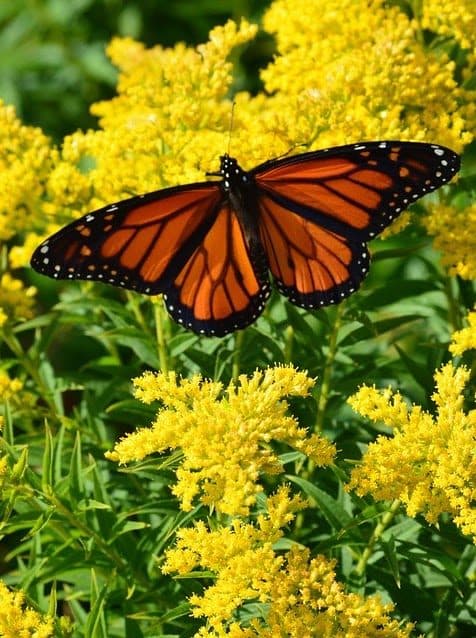
Every September the same thing happens. Roadsides and meadows across Long Island turn gold, noses start running, and goldenrod takes the blame. It is innocent. The guilty party is standing right next to it.
Why goldenrod cannot be the problem
Plants have two ways to move pollen: by wind or by insects. Wind-pollinated plants make enormous amounts of tiny, light, dry pollen and have small, dull flowers because they have no need to attract anything. Insect-pollinated plants make heavier, stickier pollen, less of it, and advertise with bright, showy flowers.
Goldenrod is the second kind. Its pollen grains are large, heavy, and sticky, built to ride on a bee. They fall within a few feet of the plant. Studies of airborne pollen counts find goldenrod at trace levels even in the middle of a goldenrod meadow. You would have to bury your face in the flowers to react to it, and even then most people would not.
The real culprit: ragweed
Common ragweed (Ambrosia artemisiifolia) and giant ragweed bloom at exactly the same time, mid-August through October. They are wind pollinated, and a single ragweed plant releases about a billion pollen grains in a season, light enough to travel hundreds of miles. Ragweed pollen is the leading cause of fall hay fever in North America.
Ragweed grows in the same disturbed roadsides, field edges, and vacant lots as goldenrod, but you never notice it: the flowers are small green spikes with no petals. You see the goldenrod, you sneeze, you draw the wrong conclusion.
| Goldenrod | Ragweed | |
|---|---|---|
| Flowers | Bright yellow plumes, showy | Small green spikes, easy to miss |
| Pollen | Heavy, sticky, insect-carried | Light, dry, windborne by the billions |
| Leaves | Long, narrow, often toothed | Deeply cut, fern-like (common) or huge three-lobed (giant) |
| Allergy risk | Negligible | The leading cause of fall hay fever |
Why goldenrod belongs in your garden
Goldenrod is arguably the most important late-season plant in the eastern United States. On Long Island it fuels the September monarch migration along with asters, supports more than a hundred species of caterpillars that feed songbirds, and feeds dozens of specialist bees that collect pollen from nothing else. Soldier beetles, locust borers, paper wasps, and bumble bees crowd its flowers when almost nothing else is blooming.
For a garden, choose a clumping species that stays put: showy goldenrod (Solidago speciosa), stiff goldenrod (S. rigida), or wrinkleleaf goldenrod 'Fireworks'. Avoid Canada goldenrod, which spreads aggressively by rhizome. In the Theodore Roosevelt Sanctuary planter we used a compact one-foot selection that blooms August through October and fits in a container.
Read more on our goldenrod plant page, and if you still have doubts, stand in a goldenrod patch in September and breathe. Then go find the ragweed.
Sources
- Asthma and Allergy Foundation of America, "Ragweed Pollen Allergy" - https://aafa.org/allergies/types-of-allergies/pollen-allergy/ragweed-pollen/
- National Wildlife Federation, "The Goldenrod Allergy Myth" (2014) - https://blog.nwf.org/2014/09/the-goldenrod-allergy-myth/
- University of Illinois Extension, "Autumn Allergies: Don't Blame Goldenrod" (2022) - https://extension.illinois.edu/blogs/good-growing/2022-10-21-autumn-allergies-dont-blame-goldenrod
- National Wildlife Federation, "Power Plants: Keystone Native Plants," National Wildlife magazine (2022) - https://www.nwf.org/Home/Magazines/National-Wildlife/2022/April-May/Conservation/Keystone-Plants
Written by Aidan and Ben Ellis of Pollinate Happiness, Long Island, NY. Found an error? Let us know.