Where it came from
Europe, western Asia, and North Africa.
How it got here
Brought by European colonists in the early 1700s as a ground cover and wall covering, evoking the ivy-covered halls of home. It has been sold continuously ever since and is still one of the most common landscape plants on Long Island.
What it does to the ecosystem
As a ground cover it smothers native wildflowers and tree seedlings in a solid evergreen mat. Climbing, it weighs down and shades trees, holds moisture against bark, and hides decay. Once it climbs and matures, it flowers and fruits, and birds spread it into every nearby woodland. It also hosts bacterial leaf scorch, which kills oaks and elms.
What it costs
Removal from woodlands is slow hand labor. Trees weakened by ivy fall in storms; ivy-covered walls need repointing.
Don’t confuse it with
- Poison ivy (native). Poison ivy has three leaflets and hairy aerial roots; English ivy has single lobed evergreen leaves. Virginia creeper has five leaflets.
How to identify it
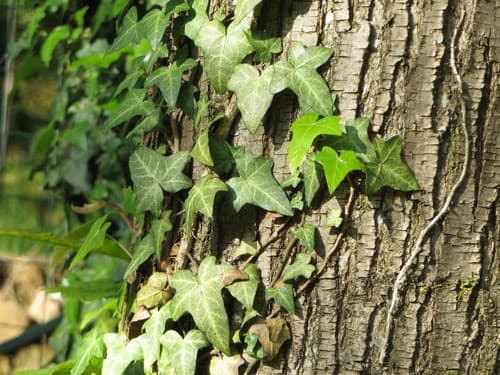
Evergreen vine with lobed, waxy dark green leaves (juvenile) or unlobed leaves and black berries on climbing adult stems.
What to do
Cut vines around tree trunks at chest and ankle height and pull the ground layer in sections. Replace with native ground covers.
On Long Island
Carpets the floor of nearly every North Shore estate woodland and older neighborhood. Cut climbing vines at chest and ankle height and pull the ground layer in sections.
Worth knowing
- Juvenile ivy climbs and has lobed leaves; adult ivy stops climbing, grows shrubby, has unlobed leaves, and only then flowers and fruits.
- The adult flowers in October are an important late nectar source for bees and wasps, one of few things in its favor.
- Oregon and Washington have banned its sale; New York has not.