Where it came from
Northern and central China and Taiwan.
How it got here
Brought to Philadelphia in 1784 by a gardener named William Hamilton as a fashionable, fast-growing shade tree, and again to California by Chinese immigrants during the Gold Rush. Nurseries sold it widely through the 1800s because it tolerated coal smoke and poor city soil, which is exactly why it now grows in every railroad cut and vacant lot in the Northeast.
What it does to the ecosystem
It grows several feet a year, seeds by the hundreds of thousands, and sends up root suckers 50 feet from the parent. Its roots and leaves release ailanthone, a chemical that suppresses germination of other plants around it, so stands become monocultures. It is also the preferred host of the spotted lanternfly, whose populations build up on it before spreading to grapes and maples.
What it costs
Suckers crack foundations, sewer lines, and pavement. Because cutting triggers dozens of new stems, removal usually requires repeated herbicide treatment over several years. Its role as a lanternfly nursery adds to the cost borne by vineyards and orchards.
Don’t confuse it with
- Staghorn sumac (native). Sumac leaflets are toothed along the whole edge and the twigs are fuzzy; tree-of-heaven leaflets are smooth-edged with one or two notches at the base, and crushed leaves smell like rancid peanut butter.
- Black walnut (native). Walnut leaflets are toothed and the crushed leaves smell spicy, not foul.
How to identify it
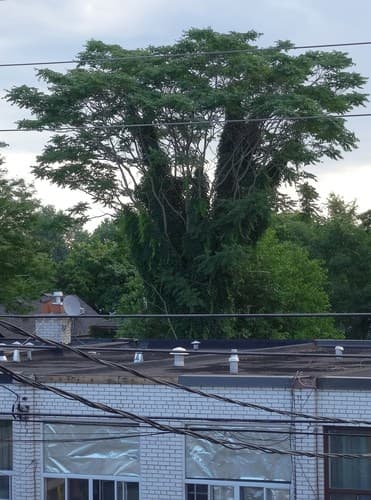
Fast-growing tree with long compound leaves (up to 3 ft) with a notched gland at the base of each leaflet; crushed leaves smell like rancid peanut butter. Often mistaken for sumac or black walnut.
What to do
Do not just cut it; cutting triggers dozens of root suckers. Treat cut stumps or use a basal bark herbicide in late summer, then remove. Report to iMapInvasives.
On Long Island
Common along the Long Island Rail Road, parkway edges, and any disturbed ground in Nassau and Suffolk. Removing it from your property is the single most effective thing you can do against spotted lanternfly.
Worth knowing
- This is the tree in the 1943 novel A Tree Grows in Brooklyn, chosen because it grows where nothing else will.
- A single female can produce more than 300,000 winged seeds in a year.
- The scientific name altissima means tallest, though it rarely tops 80 feet.