Where it came from
Eastern Asia from India through China and Japan.
How it got here
A contaminated shipment of holly seed from Japan brought it to a nursery in York County, Pennsylvania, around 1930. The nursery owner found the odd triangular vine interesting and let it grow. Everything in the eastern United States descends from that patch.
What it does to the ecosystem
An annual vine that grows up to six inches a day, it blankets shrubs, tree seedlings, and young forest plantings under a solid layer of leaves, killing them by shading. It thrives in the wet, sunny edges where native shrubs would otherwise regenerate.
What it costs
Foresters replanting after logging or storms lose whole plantings to it. Its barbs make hand removal painful, and it has spread through the Mid-Atlantic faster than any other recent plant invader.
Don’t confuse it with
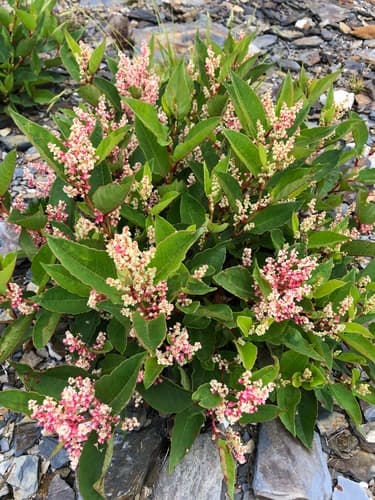
- Halberd-leaved tearthumb and arrow-leaved tearthumb (native). Native tearthumbs have arrowhead-shaped leaves, not perfect equilateral triangles, and pink flower clusters rather than metallic blue berries.
How to identify it
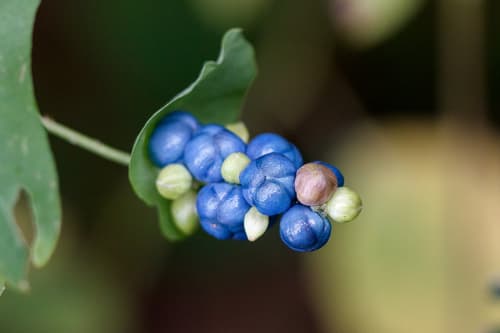
Perfectly triangular light-green leaves, recurved barbs along the stems, saucer-shaped leafy cups at the nodes, and metallic blue berries in late summer.
What to do
Pull before it sets seed in July; wear gloves. Repeat visits for several years to exhaust the seed bank. Report new populations, which are still spreading across Long Island.
On Long Island
Arrived on Long Island in the 2000s and is still expanding, especially in Suffolk County wetlands and utility rights-of-way. This is one where early reporting genuinely matters.
Worth knowing
- A biological control weevil from China, released since 2004, now eats it across the Mid-Atlantic and has slowed it noticeably.
- Seeds float and stay viable in water for a week, which is how it moves down streams.
- Its berries look blue, but the color comes from the fleshy sepals; the true fruit inside is a black, shiny achene.