Where it came from
Japan, Korea, and eastern China, where it colonizes volcanic slopes.
How it got here
Philipp von Siebold, a German physician, shipped it from Japan to his nursery in the Netherlands in the 1840s, and it won a gold medal as the most interesting new ornamental of 1847. It reached American gardens by the 1870s and was also planted to stabilize stream banks and screen railroad tracks.
What it does to the ecosystem
Its rhizomes spread 20 feet sideways and 10 feet deep and regrow from a fragment the size of a fingernail, so every flood and every mowing plants more. Dense stands shade out everything else, and the bare soil under the canes erodes when the plants die back each winter, degrading stream banks it was meant to protect.
What it costs
In the United Kingdom, knotweed on a property can block a mortgage, and the national eradication estimate runs into the billions of pounds. Here, it damages pavement and foundations and can take five years of treatment to exhaust.
Don’t confuse it with
- Giant knotweed and Bohemian knotweed. Also invasive; giant knotweed has leaves more than a foot long with heart-shaped bases. Treat them the same way.
How to identify it
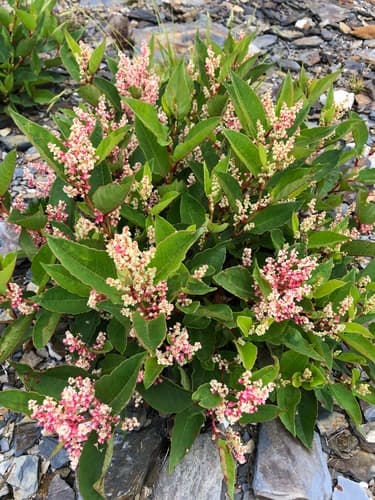
Bamboo-like hollow stems with red speckles, zig-zag branching, heart-shaped leaves with a flat base, and sprays of tiny white flowers in late summer.
What to do
Never mow or dig without a disposal plan; every fragment roots. Repeated cutting plus late-season herbicide over several years is the usual approach. Report it.
On Long Island
Widespread along streams and roadsides on the North Shore and in disturbed lots island-wide. Report new stands to iMapInvasives before they reach a watercourse.
Worth knowing
- Nearly every Japanese knotweed plant in North America and Europe is a female clone of a single introduction; it spreads by fragments, not seed.
- Young spring shoots are edible and taste like rhubarb, but never move cuttings; that is how it spreads.
- Beekeepers value its late-summer nectar, one of the few things to be said for it.