Where it came from
Northeastern Asia: China, Korea, and Japan.
How it got here
Introduced to the United States around 1860 for its brilliant scarlet fall color and corky winged stems. It became one of the most-planted shrubs in America, lining parking lots and foundations from coast to coast.
What it does to the ecosystem
Birds spread the seed into woodlands, where seedlings form dense carpets that shade out native wildflowers and tree seedlings. It tolerates deep shade, so it invades intact forest, not just edges.
What it costs
Still legal to sell in New York with a warning label, so new plantings keep feeding woodland invasions. Removal from preserves is ongoing work.
Don’t confuse it with
- Eastern wahoo (native). Wahoo lacks the corky wings on the twigs and has showy pink-and-orange fruit; its fall color is softer red.
How to identify it
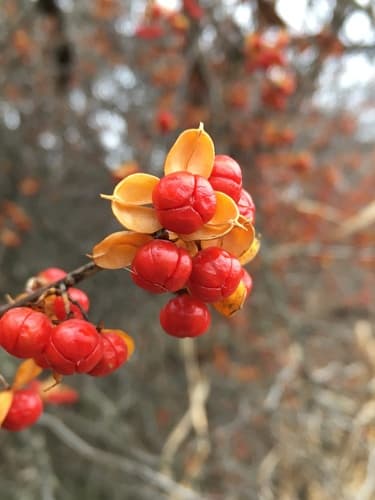
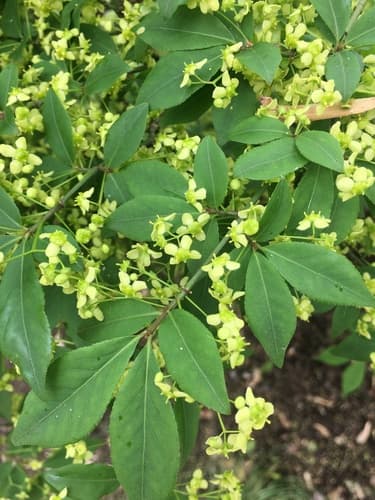
Corky wings along the twigs, opposite leaves that turn brilliant scarlet in fall, and small orange-red fruit.
What to do
Remove from home landscapes and replace with a native that gives the same fall color. Seedlings pull easily.
On Long Island
Common in North Shore woodlands and along preserve edges wherever there are older suburban plantings upwind. Seedlings pull easily.
Worth knowing
- The winged twigs gave it another common name, winged spindle-tree.
- Highbush blueberry gives the same scarlet fall color, feeds 280 species of caterpillars, and produces fruit; burning bush feeds almost nothing.
- Massachusetts and New Hampshire have banned its sale outright.