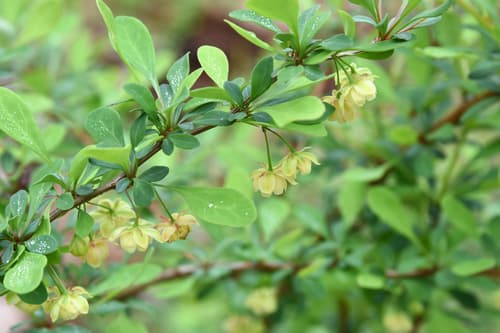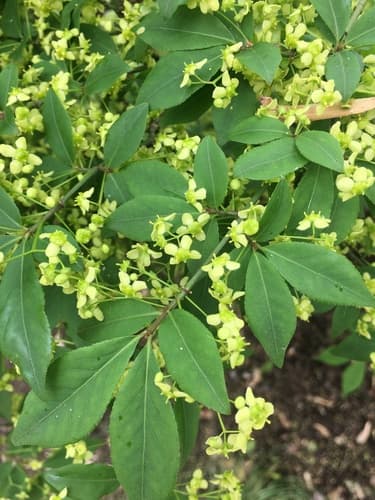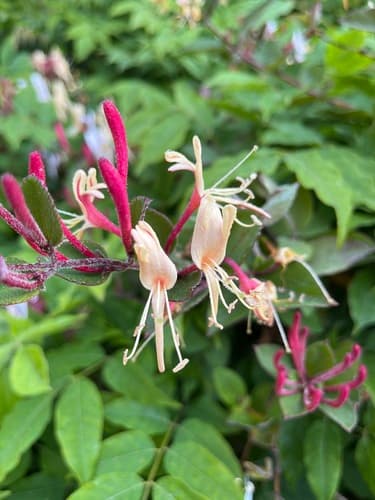
Where it came from
Japan, Korea, and eastern China.
How it got here
Introduced to Long Island in 1806 as an ornamental vine, and later planted across the country for erosion control and as deer forage. Its sweet-scented flowers made it a garden favorite for 150 years.
What it does to the ecosystem
The semi-evergreen vine keeps growing after natives go dormant, so it gets a head start every spring. It twines around saplings and girdles them, blankets shrubs, and forms mats that exclude ground-layer plants. It thrives on forest edges and in the gaps storms create.
What it costs
One of the most widespread invasive vines in the eastern United States, degrading forest regeneration across millions of acres.
Don’t confuse it with
- Trumpet honeysuckle (native). Trumpet honeysuckle has red tubular flowers, orange-red berries, and the top pair of leaves fused around the stem. Japanese honeysuckle has white-to-yellow flowers in pairs and black berries.
How to identify it
Twining vine with opposite oval leaves that stay green into winter, fragrant white-to-yellow paired flowers, and black berries.
What to do
Pull or cut and treat; it roots wherever stems touch ground. Replace with the native red-flowered vine hummingbirds prefer.
On Long Island
Ubiquitous on fence lines, hedgerows, and woodland edges in both counties. Replace with trumpet honeysuckle, which hummingbirds prefer anyway.
Worth knowing
- It was introduced through a Long Island nursery, so this one is partly our fault.
- Its flowers open white and turn yellow after pollination, hence the folk name gold-and-silver flower.
- Children who learned to pull the flower and sip the nectar drop were sampling one of the most widespread weeds in the country.