Where it came from
Europe and temperate Asia.
How it got here
Arrived in the early 1800s in ship ballast, which was dumped along the Northeast coast, and in wool and livestock bedding. Gardeners then planted it deliberately for its spikes of magenta flowers, and beekeepers spread it as a nectar plant.
What it does to the ecosystem
A single plant makes up to two million tiny seeds a year that float, and the woody rootstock lives for decades. It converts diverse cattail and sedge marshes into loosestrife monocultures with far less food and cover for ducks, rails, turtles, and amphibians.
What it costs
By the 1990s it covered hundreds of thousands of acres of North American wetland and was costing tens of millions of dollars a year in control and lost wetland function. Biological control beetles introduced from Europe have since knocked many stands back dramatically.
Don’t confuse it with
- Blue vervain and swamp loosestrife (native). Blue vervain has slender violet spikes and square stems but small five-petaled flowers; swamp loosestrife has arching stems and pink flowers in the leaf axils, not on a spike.
- Dense blazing star (native). Blazing star grows in dry meadows, not marshes, and its purple spike opens from the top down.
How to identify it
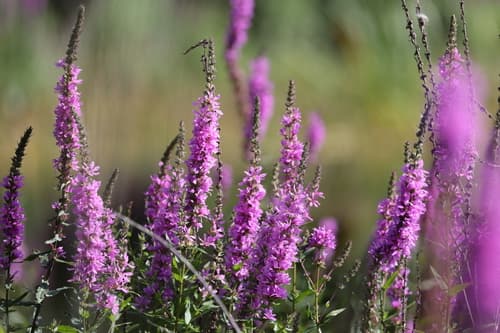
Tall spikes of magenta flowers in July and August on square stems with opposite, lance-shaped leaves, growing in wet soil.
What to do
Pull small plants before seed set; bag flower heads. Biocontrol beetles have reduced many large stands. Report new wetland infestations.
On Long Island
Less dominant than it was thanks to beetles, but still present around freshwater ponds and marsh edges across the island. Pull isolated plants before they establish a seed bank.
Worth knowing
- Two European leaf beetles, Galerucella, released since 1992 now control it across much of New York, one of the great successes of biological control.
- It was once listed in herbals as an astringent for diarrhea, hence the name.
- The flowers come in three different forms with different stamen lengths, a trick to force cross-pollination that Darwin studied.