Where it came from
Japan, Korea, and eastern China.
How it got here
Imported in 1866 as rootstock for grafted garden roses. From the 1930s to the 1960s the Soil Conservation Service and state wildlife agencies distributed millions of cuttings, urging farmers to plant it as a living fence and wildlife cover. Highway departments planted it in medians as a crash barrier.
What it does to the ecosystem
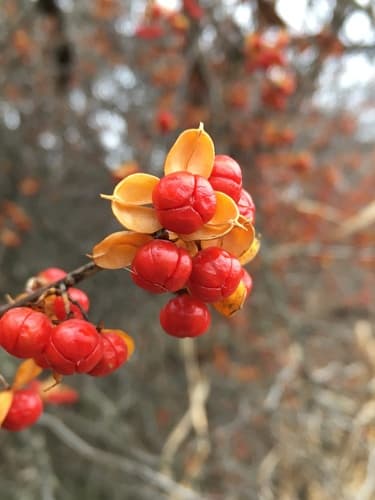
It forms impenetrable thorny mounds up to 15 feet across in pastures, old fields, and woodland edges, crowding out native shrubs and wildflowers. Birds spread the small red hips everywhere; a single plant can make half a million seeds a year.
What it costs
Farmers lose pasture to it and spend heavily on clearing. It has been declared a noxious weed in many states.
Don’t confuse it with
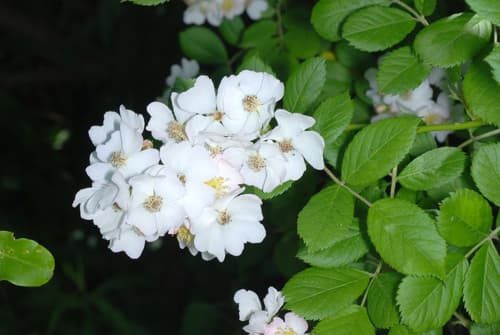
- Virginia rose, pasture rose, swamp rose (native). Native roses have pink flowers, straight or slightly curved thorns, and stipules with smooth edges. Multiflora rose has small white flowers in clusters, hooked thorns, and fringed, feathery stipules at the base of each leaf.
How to identify it
Arching canes with recurved thorns, clusters of small white flowers in June, fringed (feathery) stipules at the base of each leaf, and small red hips.
What to do
Cut and dig the root crown, or repeatedly mow. Wear leather gloves and eye protection. Rose rosette disease is slowly knocking it back.
On Long Island
Common in old fields, preserve edges, and along the LIRR. Wear leather gloves and eye protection; the hooked thorns are nasty.
Worth knowing
- Rose rosette disease, spread by a tiny mite, is killing multiflora rose across the East, but it also kills garden roses.
- The name multiflora refers to the clusters of many small flowers, unlike the single blooms of native roses.
- Its rootstock still underlies many old grafted garden roses; the suckers with white flowers are multiflora.