Where it came from
Northeastern Asia: China, Korea, Japan, and the Russian Far East.
How it got here
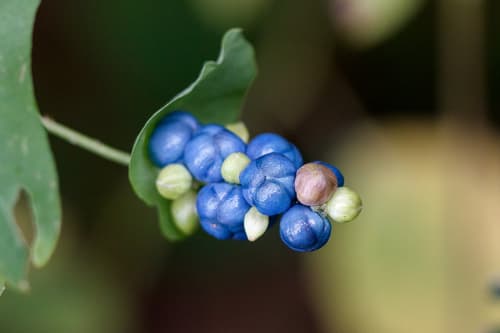
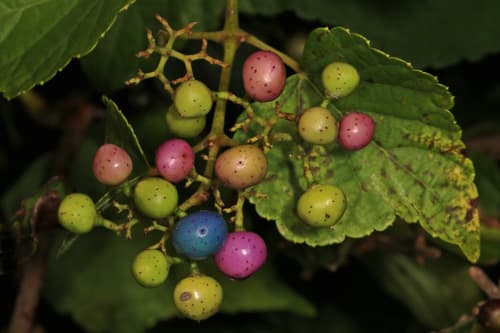
Introduced around 1870 as an ornamental vine for its speckled turquoise, lilac, and pink berries, which really are beautiful. Nurseries sold it into the 1990s, and it is still found in some old estate gardens on the North Shore.
What it does to the ecosystem
It grows 15 feet in a season and blankets shrubs and small trees along woodland edges and stream banks, shading them out. Birds relish the fruit and spread seed widely. Its heavy vines topple the shrubs that hold stream banks together.
What it costs
Hard to remove because the roots are deep and it resprouts; Nassau County and North Shore land trusts run repeated volunteer efforts against it.
Don’t confuse it with
- Fox grape and summer grape (native). Cut a stem: grape pith is brown, porcelain berry pith is white. Grape bark shreds; porcelain berry bark does not. Grape fruit is dark purple, never speckled blue and pink.
- Virginia creeper (native). Five leaflets per leaf; porcelain berry leaves are single, grape-like, and often deeply lobed.
How to identify it
Grape-like leaves, often deeply lobed, with a white pith inside the stem (grape pith is brown), and speckled berries in turquoise, purple, and pink in September.
What to do
Pull seedlings, cut and treat established vines, and remove berries before birds get them. Report new spread.
On Long Island
Among the worst woodland-edge invaders on the North Shore from Great Neck to Huntington, especially near old estates. Cut and treat vines before the September fruit.
Worth knowing
- The berries change from white to lilac to bright turquoise to purple as they ripen, all on the same cluster.
- It is in the grape family and its flowers feed bees, which is part of why it went unnoticed for so long.
- New York prohibited its sale in 2015.