Where it came from
Europe, western Asia, and northern Africa.
How it got here
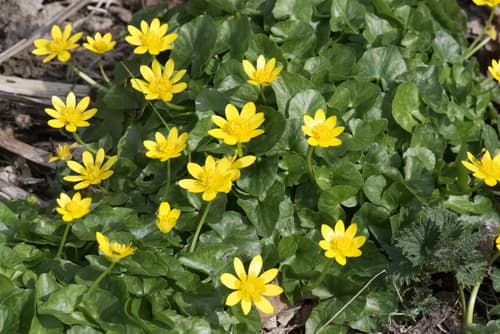
Introduced as an ornamental ground cover for its early, glossy yellow flowers; the first American record is from Pennsylvania in 1867. It is still sold in some catalogs under the name fig buttercup.
What it does to the ecosystem
It carpets floodplain forests and lawns in March and April, exactly when native spring ephemerals like trout lily, spring beauty, and bloodroot need to bloom. It shades them out, then dies back by June, leaving bare soil. It spreads by tubers and bulbils that wash downstream with every flood.
What it costs
Extremely difficult to control because every bulbil left behind regrows. Infested parks in New York City and Philadelphia have lost most of their native spring wildflowers.
Don’t confuse it with
- Marsh marigold (native). Marsh marigold is larger, has five to nine petals, no tubers, and grows only in wet places. Lesser celandine has eight or more narrow petals, tubers, and grows in lawns and floodplains alike.
How to identify it
Low rosettes of shiny heart-shaped leaves and bright yellow eight-petaled buttercup flowers in March and April; tiny tubers and bulbils spread it.
What to do
Hard to control by hand because of the bulbils. Dig small patches carefully and bag all soil; larger areas need targeted early-spring treatment. Report it.
On Long Island
Spreading along streams and in floodplain woods in Nassau County parks. Dig small patches carefully with all soil and report larger ones.
Worth knowing
- Wordsworth loved it and wrote three poems about it; it is carved on his memorial.
- It was called pilewort because the knobby tubers resembled hemorrhoids, which it was used to treat.
- It is one of the first flowers of spring and one of the first to vanish; by June there is no trace above ground.