Where it came from
Europe from France to the Caucasus.
How it got here
John Bartram of Philadelphia sold the first Norway maples in America in 1756. After Dutch elm disease killed the elms that lined American streets in the 1930s through 1960s, cities planted Norway maples by the millions as a tough, fast-growing replacement.
What it does to the ecosystem
Its dense canopy leafs out earlier and drops later than native maples and casts shade so deep that nothing grows beneath it, not even grass. Its shallow roots outcompete neighbors for water. Seedlings pour into nearby woodlands and displace sugar maple, red maple, and oak regeneration.
What it costs
Cities are now paying to remove aging Norway maples that were planted as a fix. Property owners deal with bare, eroding ground under them.
Don’t confuse it with
- Sugar maple (native). Snap a leaf stem: Norway maple bleeds milky white sap; sugar maple sap is clear. Norway maple leaves are wider than long with more lobes, and its fall color is a late, plain yellow rather than orange.
- Red maple (native). Red maple leaves have three main lobes with toothed edges and turn red in early fall.
How to identify it
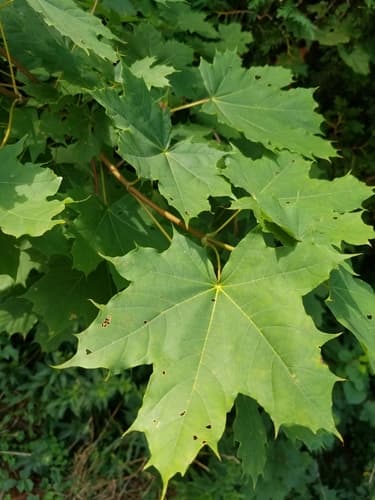
Broad, dark leaves with five to seven lobes; snap a leaf stem and it oozes milky white sap (native maples do not). Yellow fall color, late.
What to do
Do not plant. Remove seedlings from woodland edges. Replace aging trees with native shade trees.
On Long Island
The default street tree of postwar Long Island subdivisions and now a major understory invader of North Shore woodlands. Replace failing street trees with red maple, oak, or tupelo.
Worth knowing
- The purple-leaved 'Crimson King' is a Norway maple and is just as invasive.
- Its winged seeds spread wide, nearly 180 degrees apart; sugar maple seeds hang in a narrow U.
- New York regulates but does not prohibit it, so it is still sold.