Where it came from
The invasive lineage comes from Europe; a native lineage of the same species has grown in North American marshes for thousands of years.
How it got here
The European genotype probably arrived in ship ballast along the Atlantic coast in the early 1800s. It spread slowly at first, then explosively in the 20th century along new roads, railroads, and ditches, and now dominates coastal marshes from Maine to Virginia.
What it does to the ecosystem
It grows 15 feet tall in solid stands that exclude native marsh plants, fill in open water and mudflats that shorebirds and fish need, and raise the marsh surface with thatch. Its dense stands are also a wildfire hazard beside homes.
What it costs
Managing it is one of the largest expenses in salt marsh restoration on Long Island's South Shore. Homeowners near marshes pay for fire-break mowing, and dead stands have fueled brush fires.
Don’t confuse it with
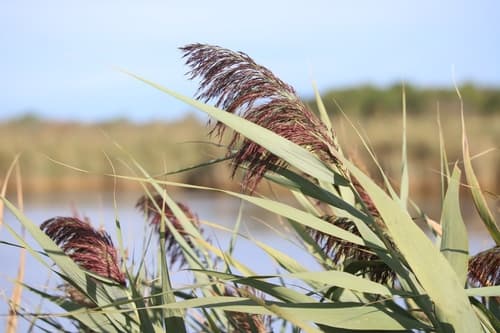
- Native Phragmites (americanus). The native has smooth, shiny, red-brown lower stems, sparser stands with other plants growing among them, and leaf sheaths that fall off in winter. The invader has dull tan ribbed stems and sheaths that stay on.
How to identify it
Grass up to 15 ft tall with feathery purple-to-tan plumes in late summer, forming solid stands. The native subspecies is sparser with smooth, shiny red-brown lower stems.
What to do
Large stands need professional management. Do not spread rhizome fragments when moving soil. Report stands in previously clean marshes.
On Long Island
Dominates the edges of the Great South Bay marshes, Jamaica Bay, and most freshwater pond margins. Native Phragmites still survives in a few spots, so confirm before you treat.
Worth knowing
- Genetic work in 2002 finally proved that the aggressive reed was a European invader, not a native gone wild.
- It reproduces mostly by rhizomes and stolons that can grow 40 feet in a year across mud.
- Ancient Egyptians used the same species for pens, and thatched roofs in England are still made from it.