Where it came from
Mexico, Central America, South America, and the Caribbean.
How it got here
Sold across the United States since the mid-20th century as an easy annual milkweed for butterfly gardens, and heavily promoted during the monarch-decline publicity of the 2000s. Big-box stores still stock it every spring, often labeled simply as milkweed.
What it does to the ecosystem
Because it does not die back on schedule, it can signal monarchs to keep breeding in fall instead of migrating, and it lets the parasite OE accumulate on leaves over months. In the Southeast it has created year-round non-migratory monarch populations with very high parasite loads.
What it costs
It complicates monarch conservation in the very gardens planted to help, and diverts sales from native milkweed nurseries.
Don’t confuse it with
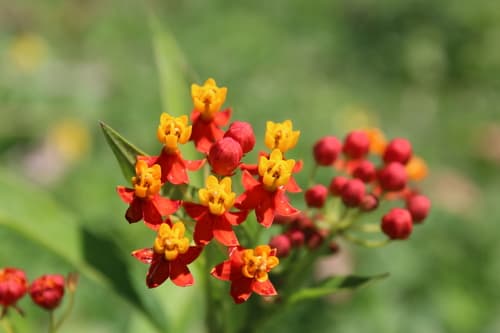
- Butterfly weed (native). Butterfly weed has flat-topped clusters of solid orange flowers and narrow leaves on stiff hairy stems. Tropical milkweed flowers are two-toned, red-orange with a yellow crown, and the plant is bushier with smooth stems.
How to identify it
Bushy plant with narrow leaves and bright red-orange and yellow flower clusters, often sold as annual milkweed or bloodflower.
What to do
Do not plant. If you have it, cut it to the ground in early fall. Choose common, swamp, or butterfly milkweed instead.
On Long Island
Frost kills it here, so it does not naturalize, but it is common in butterfly gardens. Replace with common, swamp, or butterfly milkweed.
Worth knowing
- It is not regulated in New York, which is why it is still everywhere.
- It is also called bloodflower and scarlet milkweed.
- Cutting it to the ground in early fall removes most of the risk if you already have it.