Where it came from
Amur honeysuckle is from the Amur River basin of northeast China, Korea, and the Russian Far East; Morrow's and Tatarian honeysuckles are from Japan and central Asia.
How it got here
Tatarian honeysuckle arrived in 1752 as an ornamental. Amur and Morrow's came in the late 1800s through botanical gardens, and the USDA promoted bush honeysuckles from the 1960s to the 1980s for wildlife food and erosion control.
What it does to the ecosystem
They leaf out weeks before native shrubs and hold leaves weeks later, shading out spring ephemerals and tree seedlings. Their berries are high in sugar but low in the fat migrating birds need, and nests built in them suffer higher predation because the branches are low and open. They also change forest soils and light so much that native regeneration nearly stops.
What it costs
Dominant in disturbed forests across the Midwest and Northeast. Removal is straightforward but endless without replanting.
Don’t confuse it with
- Native bush honeysuckles (Diervilla) and fly honeysuckle. Cut a twig: invasive honeysuckles have hollow brown pith; natives have solid white pith. Native fly honeysuckle has paired yellow flowers in April and red fruit joined at the base.
How to identify it
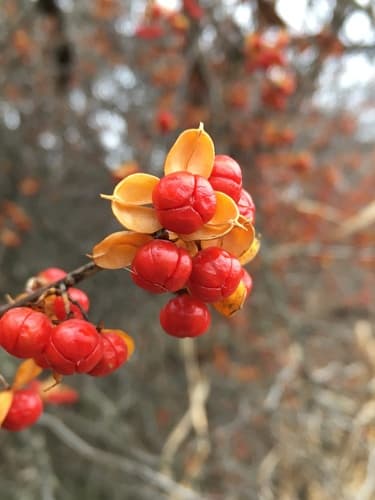
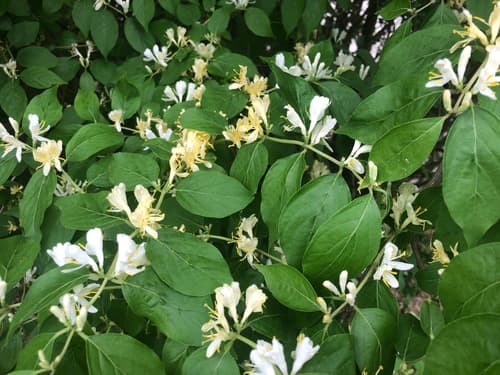
Upright shrubs with opposite leaves, hollow twigs (native honeysuckles have solid pith), paired white-to-pink flowers in May, and red berries.
What to do
Pull seedlings; cut and treat larger shrubs. Roots are shallow, so a weed wrench works well.
On Long Island
Common in disturbed woodlands, park edges, and old hedgerows. Pull seedlings; the shallow roots come up with a weed wrench.
Worth knowing
- Cardinals that eat honeysuckle berries develop orange-tinged feathers from the fruit pigments.
- The berries are mildly toxic to people.
- A single large shrub can produce more than a million seeds over its life.