Where it came from
China, Korea, and Japan.
How it got here
Introduced in 1830 as an ornamental, then planted by the millions from the 1940s to the 1970s by soil conservation agencies for erosion control, mine reclamation, windbreaks, and wildlife food. It was recommended in New York until the 1980s.
What it does to the ecosystem
It fixes nitrogen, so it thrives on the poorest soils and then enriches them, changing conditions to favor other weeds over the natives adapted to lean ground. It shades out grassland and old-field species, and birds spread its abundant fruit for miles.
What it costs
Now occupies former farmland, powerline corridors, and restored mine sites across the East. Cutting alone fails; it resprouts vigorously.
Don’t confuse it with
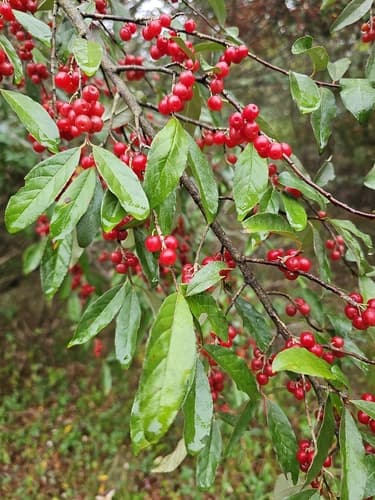
- Northern bayberry (native). Bayberry leaves are aromatic when crushed and have no silver scales; its fruit is a waxy gray berry. Autumn olive leaves are silvery underneath and its fruit is red flecked with silver.
How to identify it
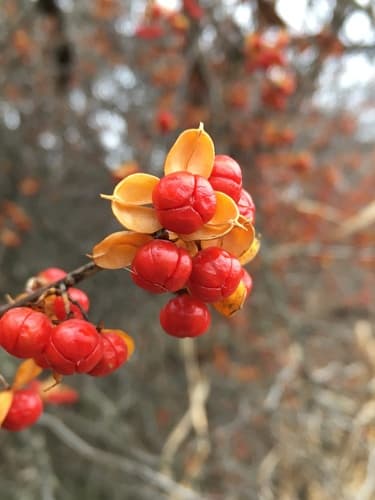
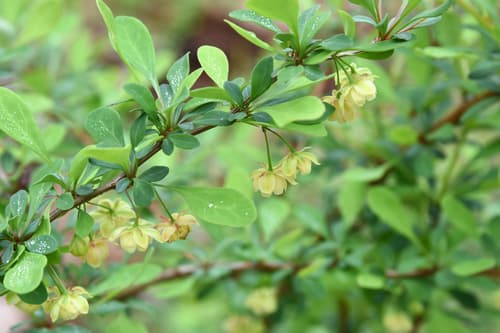
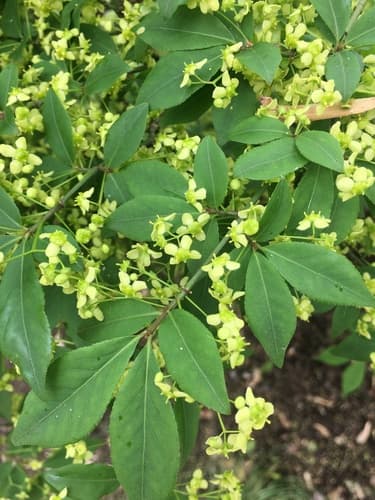
Shrub to 20 ft with silvery undersides on the leaves, fragrant pale yellow flowers in May, and red berries flecked with silver in fall.
What to do
Cut and treat stumps; pulling small plants works. Resprouts vigorously if just cut.
On Long Island
Frequent in old fields, along the LIE, and around former farmland in Suffolk. Cut and treat stumps in late summer.
Worth knowing
- The tart red berries are edible and high in lycopene, and some people make jam from them; just do not plant it.
- A mature shrub can produce 200,000 seeds a year.
- It was sold as a wildlife plant, but studies show native shrubs support far more insects and better bird nesting.