Where it came from
Japan, Korea, China, and Taiwan.
How it got here
Introduced in the late 1800s as an ornamental grass and now sold in dozens of cultivars. It is one of the most popular garden grasses in America, which is precisely the problem: it escapes from the millions of gardens where it grows.
What it does to the ecosystem
Seedlings colonize roadsides, meadows, and forest openings, forming clumps that exclude native grasses and wildflowers. Dry stands are extremely flammable and have carried wildfire in the Mid-Atlantic.
What it costs
Fire risk along highways and near homes; loss of native meadow habitat. Regulated in New York, so it is sold with a warning label.
Don’t confuse it with
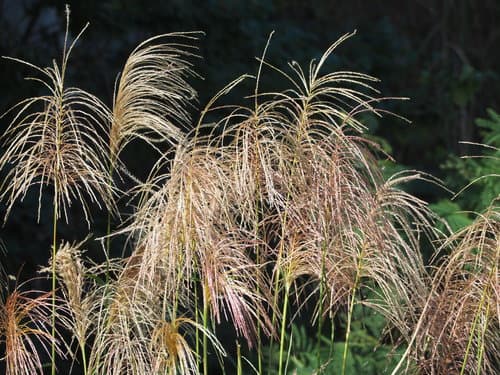
- Switchgrass, Indiangrass, and big bluestem (native). Miscanthus leaves have a white midrib stripe and its plumes are silvery and feathery. Native grasses lack the white stripe and have narrower, golden or bronze seed heads.
How to identify it
Large clumping grass to 8 ft with a white midrib stripe on the leaves and silvery, feathery plumes in fall.
What to do
Remove flower plumes before seed matures, or dig out clumps. Replace with a native grass.
On Long Island
Escaping along the LIE, Sunrise Highway, and near suburban plantings. Replace with switchgrass or little bluestem, which do the same job for the garden and feed skippers.
Worth knowing
- Some cultivars are sold as sterile, but many set viable seed, especially when planted near other cultivars.
- Giant miscanthus, a sterile hybrid, is grown as a biofuel crop and is not the same plant.
- The plumes are used in Japanese autumn moon-viewing festivals.