Where it came from
Europe, western Asia, and northwestern Africa.
How it got here
First recorded on Long Island in 1868, brought by European settlers as a garlic-flavored potherb and a folk remedy for ulcers and gangrene. It escaped kitchen gardens and now covers forest floors from Georgia to Ontario.
What it does to the ecosystem
Its roots exude chemicals that kill the mycorrhizal fungi native trees and wildflowers depend on, so even after you pull it the soil takes years to recover. It also fools native white butterflies, including the West Virginia white, into laying eggs on it; the caterpillars die. A single plant can drop thousands of seeds that last a decade in the soil.
What it costs
One of the most labor-intensive invasives to control because seed banks demand five or more years of annual pulling. Volunteer pull days across the Northeast are largely garlic mustard days.
Don’t confuse it with
- Violets and ground ivy. Garlic mustard rosettes smell of garlic when crushed; violets and ground ivy do not, and ground ivy has square stems.
- Toothwort (native). Toothwort flowers are pink-tinged, and its leaves are deeply divided rather than heart-shaped and scalloped.
How to identify it
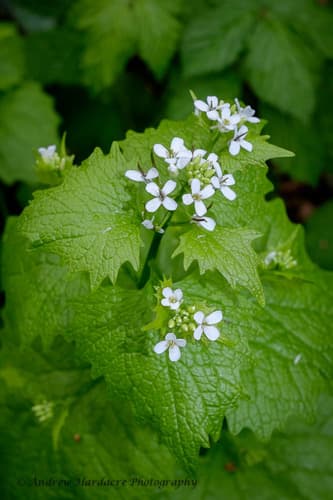
First year: rosettes of kidney-shaped, scalloped leaves that smell of garlic when crushed. Second year: 1 to 3 ft stems with triangular toothed leaves and small four-petaled white flowers in April and May.
What to do
Pull second-year plants before they set seed in May; the whole root comes up easily in moist soil. Bag and trash, do not compost. Repeat for five years.
On Long Island
In nearly every North Shore woodland and shady park. April, when it flowers and the ground is soft, is pull month.
Worth knowing
- It is one of the few plants that can invade an undisturbed, closed-canopy forest.
- Pulled plants can still set seed from stored energy, so bag them; do not leave piles.
- It is edible and makes a decent pesto, which is the one good reason to pull a lot of it in April.