Where it came from
Central China and Japan.
How it got here
Introduced to Britain in the 1890s and to America soon after. It exploded in popularity as a butterfly-garden plant in the 1980s and 1990s and is now one of the best-selling shrubs in the country.
What it does to the ecosystem
It provides nectar to adult butterflies but hosts no caterpillars, so a garden full of it produces no butterflies. Its tiny seeds blow into river gravel bars, railroad beds, and disturbed ground, where it forms thickets that displace willows and other native pioneer shrubs.
What it costs
It is a listed noxious weed in Oregon and Washington and regulated in several eastern states. Its main cost is opportunity: the space and enthusiasm it absorbs could be growing plants that feed caterpillars.
Don’t confuse it with
- Sweet pepperbush and buttonbush (native). Both are native shrubs that also draw crowds of butterflies. Pepperbush has upright white spikes in August; buttonbush has round white flower balls in July.
How to identify it
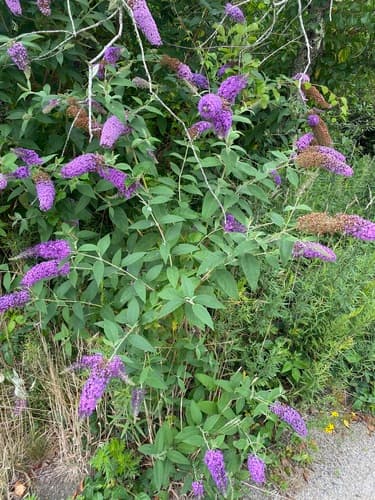
Arching shrub with gray-green lance-shaped leaves and long cones of fragrant purple, pink, or white flowers in summer.
What to do
Replace with natives that feed both adults and caterpillars; if you keep it, deadhead relentlessly and choose sterile cultivars.
On Long Island
Not yet a major escapee here, but seedlings turn up along the LIRR and on disturbed ground. Replace with sweet pepperbush, buttonbush, or Joe Pye weed.
Worth knowing
- A single plant can shed 40,000 seeds, viable for several years.
- The nectar is real; the problem is that a butterfly garden needs host plants for caterpillars, not just a bar for adults.
- Newer sterile cultivars reduce the spread problem but not the lack of caterpillar food.